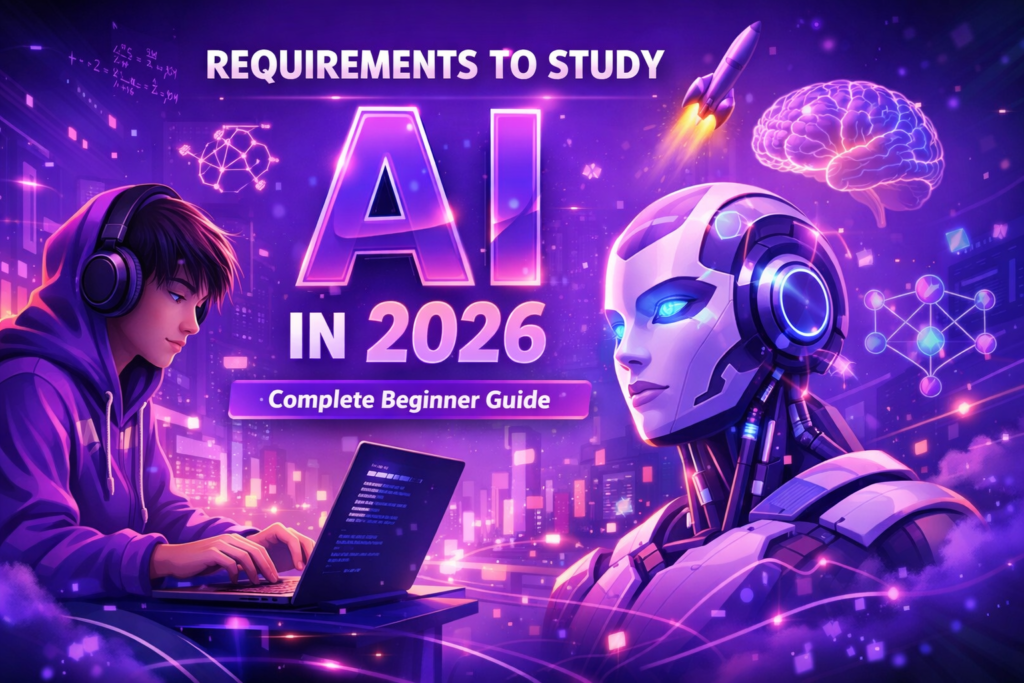

If you’re searching for the requirements to study AI in 2026, you’re already on the right path. Artificial Intelligence is no longer some futuristic concept you only see in movies—it’s literally everywhere. From the apps you scroll daily to the way companies operate behind the scenes, AI is shaping the world in real time.
If you’ve been thinking about getting into AI but feel confused about where to start, that’s completely normal. Understanding the requirements to study AI in 2026 doesn’t have to be complicated. You don’t need to be a genius or some coding prodigy to begin—you just need clarity, consistency, and the right direction.
Let’s break it down in a way that actually makes sense. 🚀
You Don’t Need to Be “Super Smart” to Start AI
One of the biggest myths about AI is that only math toppers or hardcore coders can learn it. That’s not true at all. AI is a skill you build over time, not something you’re born with.
If you stay curious, consistent, and open to learning, you’re already ahead of most people. Intelligence matters less than your ability to keep going even when things feel confusing.
When it comes to the requirements to study AI in 2026, your academic background is flexible. You don’t need a specific degree to get started. Whether you’re in school, college, or self-learning, you can begin anytime.
However, having a basic understanding of math helps. You should be comfortable with concepts like algebra, percentages, and graphs. As you move forward, you’ll naturally explore probability and statistics, which are important for understanding how AI systems make decisions.
Coding: The Most Important Skill for AI
Let’s be real—AI without coding is like trying to drive without steering. Programming is a core requirement.
The best language to start with is Python. It’s beginner-friendly, simple to read, and widely used in AI development.
You don’t need to master everything at once. Start small with basics like variables, loops, and functions. Once you’re comfortable, you can explore tools like NumPy, Pandas, and TensorFlow.
Understanding How AI Actually Works
Before jumping into tools, it’s important to understand what AI really is. At its core, AI is about teaching machines to learn from data and make decisions.
You’ll hear terms like Machine Learning, Deep Learning, and Neural Networks. Don’t let them intimidate you. Start with simple ideas—how models learn patterns, improve over time, and make predictions.
Do You Need a Powerful Laptop?
A common doubt people have about the requirements to study AI in 2026 is hardware.
The truth is, you don’t need an expensive setup to start. A basic laptop with internet access is more than enough for beginners.
As you go deeper, you might use cloud platforms or better hardware—but that’s something you can upgrade later.
Choosing the Right Learning Resources
There’s no shortage of AI learning content in 2026. From YouTube tutorials to full online courses, everything is easily accessible.
The real challenge isn’t finding resources—it’s avoiding confusion. Jumping between random tutorials slows your progress.
Pick one structured roadmap and stick to it. If you truly understand the requirements to study AI in 2026, consistency becomes much easier to maintain.
Practice Is the Real Game-Changer
Watching tutorials feels productive, but real learning happens when you build something yourself.
Start small. Try creating a basic chatbot, a recommendation system, or even a spam classifier.
You don’t need to build anything groundbreaking. The goal is to understand how things work by actually doing them.
Mindset: The Most Underrated Requirement
This might be the most important part of all. Learning AI can feel overwhelming sometimes. There will be moments when nothing makes sense—and that’s completely normal.
What separates successful learners from everyone else is simple: they don’t quit.
Stay consistent, stay patient, and avoid comparing your journey with others.
Do You Need Advanced Math for AI?
Here’s the honest answer—you don’t need advanced math to start, but you can’t ignore it forever.
As you progress, concepts like linear algebra, probability, and statistics become important. The good part is you can learn them alongside AI instead of mastering everything beforehand.
Is Learning AI Worth It in 2026?
Absolutely. AI is one of the fastest-growing fields right now. From content creation to healthcare, finance to gaming—it’s everywhere.
Learning AI doesn’t just open career opportunities. It gives you a future-proof skill that will stay relevant for years. Whether you want to freelance, build projects, or land a high-paying job, AI can take you there.
Final Thoughts
Now that you clearly understand the requirements to study AI in 2026, getting started becomes much easier. You don’t need expensive courses, a fancy degree, or perfect knowledge to begin. You just need a clear path and the discipline to stay consistent.
In 2026, the biggest advantage is starting early. While others are still thinking about it, you can already be building skills that set you apart.
So don’t wait for the perfect time. Start now, stay consistent, and trust the process. 🚀